Monday, July 20, 2009

A Shakespearean Mahabharata with Peter Brook


While I give credit to Peter Brook for managing the difficult task of compressing the essentials of the Mahabharata into a five hour movie, the movie-drama left me desiring a lot more. For a Westerner to make a play out of the Mahabharata was always going to be difficult, and though Brook undoubtedly put in a lot of effort into it, it was far from perfect.

Peter Brook's idea of starring international artists impressed me. Brook's idea was to give the impression that he was not telling the story of just a couple of kingdoms of India, but the story of the entire world. Indeed, the anthropological distribution of India must have been a lot diverse before the 400-800 year span during which the Mahabharata was composed. India must have had a lot of different tribes - Huns, Sakas, Kushanas etc., each with different a physique and a different facial feature. However, having an international cast does have its challenges - some of which Brook made no attempts at overcoming. The least he could have done was to give his actors a short course on Sanskrit pronounciation. In fact, the pronounciation of Indian names was so bad, that at one point of the play, that even the person who wrote the official sub-titles for the DVD wasn't able to understand it - the actor was uttering Bramha's name, while the sub-title read Rama.

We can forgive Peter Brook on the grounds that the primary spectators he was targetting were all Westerners, more used to Brook's Shakespearean productions. Indeed, it hardly seemed like an Indian tale, rather like an attempt at creating a Shakespearean drama. Soliloquis, short and long, filled the play. Amba's apparition to Bhishma reminded one of the Apparition of his father seen by Hamlet. At times, the costume was reminiscent of the Greek tragedies. And indeed, in crafting Karna's character, Brook may have attempted a half-hearted Shakespearan tragedy. While all of the above may be pardonable, what, in my view is unpardonable, was that Brook tried to so much make a Shakespearean play out of the Mahabharata that he even inserted Shakespeare like crude humour into his play. This is something I find completely unjustifiable - Shakespeare had to insert crude humour into his plays for the benefit of the groundlings of the Globe and Blackfrairs, but Brook's receivers are likely to be more educated.

There is some fresh breath in this play, that is a welcome break from the stale air of most of the Indian productions of Mahabharata. The costumes are more simple, less gaudy and more realistic. Most of the battle was dramatized without resort to the bitter-tasting computer graphics. Karna's tragedy is very well highlighted - something many reproductions of the Mahabharata failed to do (especially CR's Mahabharata).

While it is common for directors to take liberty with Shakespeare's plays, whether pardonable or not, hacking and hewing what Shakespeare wrote, bending the plot a little here and there, cutting a few lines there, a scene here, a soliloquy there; such twisting and turning of an epic like the Mahabharata may not be acceptable and may be seen as a cardinal sin. After all, aren't you trying to tell an ancient tale to a Western audience who has never heard it? And if this is the case, then is it not your duty to be factually correct? I was shocked to see that in his play it was Vyasa, and not Vidura (in fact Vidura hadn't been introduced at all - obviously, Brook didn't want to confuse his Western audience with too many characters, and made do with whatever characters he already had), and this is unforgivable.

Another shortcoming of this play was that it failed to depict that the Mahabharata was not just a war between the Kauravas and Pandavas, but it was a war in which the entire Indian nation took part - right from Afghanistan (Gandhara) to Manipur and Burma. I feel that depicting this aspect was very important, as this was something that could have touched a chord in the hearts of the Western audience Brook was targeting, since his audience would have experienced something similar during the first and second world wars. In fact, this book wouldn't be called the Mahabharata (or Great India) if the entire Indian sub-continent hadn't taken part in it. Mahabharata not only tells (allegorically) the political history of India, but also tells the social and economic history, and while Brook covered a part of the political history, covering the socio-economic history in a five hour production was near impossible and he can't be blamed for not covering it.

I liked the way the play ended profoundly referring to the final illusion. Most Indian productions would have saffronized this, but not being trained earlier, allowed Brook to interpret this in a broader sense.
You have known neither paradise nor hell. Here there is no happiness, no punishment, no family, no enemies. Rise in tranquility. This is the last illusion.

Brook's exploitation of the Rabindra Sangeet style of music is also interesting and adds a charm to the production.

There weren't many Indian actors in the production - in fact only one who had a major role - Mallika Sarabhai played Draupadi. Her performance was marked with a couple of brilliant scenes, but the rest of it was mediocre. There were good performances from the characters of Krishna, Duryodhana, Yudhishthira, Arjuna, Gandhari, and Karna (aided by fluent soliloquies, the best of all).

At the end, I'd like to say that it was not a bad attempt, but Brook's Shakespearean legacy let him down. He could have done a lot better, had he not tried to invent a Shakeaspearan drama out of the Mahabharata.

Monday, July 13, 2009

This little froggy took a big leap,
This little froggy took a small,
This little froggy leaped sideways,
And this little froggy not at all,
And this little froggy went,
hippity, hippity, hippity hop, all the way home.

In Bengali, the word for mushroom translates literally to Frog's Umbrella. I remember reading books as a child, with pictures of a frog under a mushroom. The pity is that my children may only see frogs in their alphabet books, as most species of frogs are now critically endangered, and many totally extinct.

In 2007, David Attenborough, shooting for the BBC series "Life in Cold Blood" in 2007, visited the last breeding site of the very beautiful and once abundant golden frog in Panama. Fighting time, the scientists studying the golden frog for years waited for the shooting to complete, before removing the last of the golden frogs from the wild and transporting them to a special facility.

A story that appeared in the National Geographic Magazine in April 2009 really moved me. I will paste verbatim an extract from it which made me really sad:
A slender man with a camper's stubble and a soft demeanor squats at the side of pond number 100, bordered by stoic rock walls and edged with pink mountain heather and tangled grasses. Vance Vredenburg is a biologist at San Francisco State University, and he's been studying the mountain yellow-legged frog for 13 years, slumming in a tent on the mountainside for weeks at a time as he monitors 80 different study lakes. Today, mosquito net balled up around his neck, he contemplates ten dead frogs, stiff-legged, white bellies going soft in the sun.

"It wasn't long ago when you walked along the bank of this pond," he recalls, "a frog leapt at every other step. You'd see hundreds of them alive and well, soaking in the sun in a writhing mass." But in 2005, when the biologist hiked up to his camp anticipating another season of long-term studies, "there were dead frogs everywhere. Frogs I'd been working with for years, that I'd tagged and followed through their lives, all dead. I sat down on the ground and cried."

The rest of the article can be read here.

While man has been partially responsible for this mass extinction of amphibians, which are the most ancient of all back-boned animals, by destroying their habitat, the major contribution to this extinction comes from a fungal infection. The fungus called Chytridiomycosis infects the skin of the frogs, hindering their breathing, and choking them to death (frogs breathe through their skins). The fungus is so potent that it has spread to all continents; more than 170 species have already been wiped out by this fungus; more than 1900 species are on the verge of extinction due to this fungus.

The virus first appeared in the African clawed frogs, which have developed a resistance to the fungus due to the presence of anti-biotic producing pro-biotic bacteria in their skin. In the last few decades, the African clawed frog was transported all over the world in large numbers, which could be one of the reasons for this amphibian epidemic. As most frogs around the world had never been exposed to the fungus, thereby having developed no genetic resistance to the fungus, they quickly succumbed to the fungus. Another theory suggests that the fungus suddenly increased in virulence, which the frogs were unable to cope up with. However, the former argument sounds stronger. Carrying species from one continent to another in jet planes has never been a good idea, and we have seen many times in the past the environmental ramifications of such alien introductions.

Government policies worldwide has helped this mass extinction of the amphibians. A few years ago, there was a massive plan to introduce fish into the pristine fish-less upstream waters of rivers. Trouts were introduced into these fish-less waters by dropping from airplanes (incidentally, many of these missed their mark, leaving fish rotting in the forests). This spelt doom for the frogs. Tadpoles are the primary food of trouts, and these tadpoles in these previously fish-less waters had no reason to develop defenses against fishes, and were consequently quickly eaten.

Some conservationist groups are trying to combat the virus (which, in some areas is spreading as quickly as 25 miles a month), by collecting frogs from the wild, and treating them with anti-fungal medicines. Other efforts are aimed at using the bacteria that protects the African clawed frog against the virus in combating the epidemic, but such research may take a while.

Indeed, the future does seem bleak for these amphibians, which are the oldest land-dwelling vertebrates. These amphibians, which saw the dinosaurs come and go, are facing the worst winter of their existence on the planet, and may not see another spring.

Friday, July 10, 2009

Since everybody is discussing homosexuality these days - reports of gay penguins exercising their right to adopt children and article 377 pottied, flushed and disinfected in everybody's mouth and in everybody's morning newspaper - why should I be left out. After all, I have a metabolic requirement to be cool too - and my blog needs to be more happenning (that, incidentally, was the word a friend used to describe what I was not when I told him that I spend most of my leisure hours at home pressing 'j' on google-reader instead of 'partying'. Well, that wasn't quite the word he used; the word he quite used used was 'socializing').

A few years ago, the news that the first homosexual tigers were observed in the wild, made it to the front page of the Times of India, and it seemed to have a sort of an appeal to wannabe post doctorates of the sort who ran an experiment on fifty or so couples feeding the husbands different diets on different weeks, and feeding the wives the resulting cum, and doing a regression line analysis plotting the taste of food of the men on the X-axis, and the taste of food (oopsie!) of the females on the Y-axis. (You may not believe me, and might like to check on this yourself, but it was a research project conducted by some university somewhere).

Tigers are mostly solitary creatures, and the chances of one of them finding a fuck may be small given their current population - thanks to project tiger and Chinese medicines - providing me enough justification to undermine the hullabaloo over Columbus' discovery of gay tigers.

A more recent non-human homosexual observation was made on a gay penguin couple. (Oopsie! Apologies. Blame that on an unconscious grammatical error, without any ill feeling towards the observer. The Corrected sentence should read something like, "Human observation of non-human homosexuals, aka gay penguins). BTW, just in case you are wondering if this has anything to do with 8mm films, they didn't go through the American Board of Film Certification to get themselves 13X rated. What made it even more interesting that the gay penguin couple adopted and raised a penguin chick.

Jokes aside, what is extraordinary about this incident is that these gay penguins shouldn't have had any difficulty in finding a mate of the other sex who was ready to copulate with them. Why, then, did they choose to remain gay?

I haven't been able to find the answer to this question, and I doubt if scientists have. But is this the only question to be answered? There are a couple more. Is homosexuality a product of the mind - a mere matter of taste (acquired or otherwise), or does it have a deeper genetic root? And if it does have a, either partial or total, genetic root, is it a wide-spread phenomena that happened throughout the history of higher animals to a certain percentage of the population, or was it always a stray phenomena arising out of genetic aberrations, which were to be soon eliminated out by natural selection?

Perhaps a clue might lie in this question. Is homosexuality totally meaningless in creatures in which fertilization is external, rather than internal? Have the plants, frogs or coral polyps found any parallels of the homosexuality which has been observed in us mammals, which we are yet to observe, recognize or understand?

Monday, June 08, 2009

When I made my decision to become a vegetarian more than twelve years ago, little did I know the environmental effects of my personal decision. At that time, the decision to turn a vegetarian was solely guided by my reluctance to cause pain to other animals for my food. Today, I realize that the decision I then made goes beyond what I could have imagined at that stage.

To produce one kilogram of potatoes, a hundred litres of water is needed; to produce one kilogram of rice, four thousand litres; and to produce one kilogram of meat, thirteen thousand litres of water is required. The choice to turn a vegetarian helps the environment at a time where the world's fresh water reserves are running low. In most places, ground water, which is non-renewable, has already been over-exploited, mainly for agricultural use. Major rivers have been diverted for mega irrigation projects to the extent that one out of ten rivers of the world no longer flow to the sea. The state of the once vast Aral sea, now reduced greatly in size manifest what we have done with our fresh-water reserves.

With every extra cow grown, we put extra pressure on our atmosphere; the production and transport of huge quantities of livestock is something that the atmosphere can no longer bear. 95% of the world's soya bean produce is used to feed livestock. 50% of the world's agriculture trade is redirected towards livestock feed. The Cornell website gives us these shocking statistics that govern production of meat:

Animal protein production requires more than eight times as much fossil-fuel energy than production of plant protein while yielding animal protein that is only 1.4 times more nutritious for humans than the comparable amount of plant protein, according to the Cornell ecologist's analysis.

Tracking food animal production from the feed trough to the dinner table, Pimentel found broiler chickens to be the most efficient use of fossil energy, and beef, the least. Chicken meat production consumes energy in a 4:1 ratio to protein output; beef cattle production requires an energy input to protein output ratio of 54:1. (Lamb meat production is nearly as inefficient at 50:1, according to the ecologist's analysis of U.S. Department of Agriculture statistics. Other ratios range from 13:1 for turkey meat and 14:1 for milk protein to 17:1 for pork and 26:1 for eggs.)

Animal agriculture is a leading consumer of water resources in the United States, Pimentel noted. Grain-fed beef production takes 100,000 liters of water for every kilogram of food. Raising broiler chickens takes 3,500 liters of water to make a kilogram of meat. In comparison, soybean production uses 2,000 liters for kilogram of food produced; rice, 1,912; wheat, 900; and potatoes, 500 liters. "Water shortages already are severe in the Western and Southern United States and the situation is quickly becoming worse because of a rapidly growing U.S. population that requires more water for all of its needs, especially agriculture," Pimentel observed.

Livestock are directly or indirectly responsible for much of the soil erosion in the United States, the ecologist determined. On lands where feed grain is produced, soil loss averages 13 tons per hectare per year. Pasture lands are eroding at a slower pace, at an average of 6 tons per hectare per year. But erosion may exceed 100 tons on severely overgrazed pastures, and 54 percent of U.S. pasture land is being overgrazed.

"More than half the U.S. grain and nearly 40 percent of world grain is being fed to livestock rather than being consumed directly by humans," Pimentel said. "Although grain production is increasing in total, the per capita supply has been decreasing for more than a decade. Clearly, there is reason for concern in the future."


One billion people around the world today go hungry. The earth has enough land to produce crops to feed all these one billion hungry people if others reduce their consumption of meat.

Every-day more and more forest land is cleared to make way for agriculture, the produce of which is invariably redirected towards livestock-feed, production of oil, or bio-fuels. Only a few decades ago, Borneo was covered primarily by a diverse and rich rain-forest which should have been protected as a world heritage site and a biosphere reserve. Instead, 90% of Borneo's forests have been wiped out to make way for palm plantations to feed the growing demand for palm oil. It is unimaginable that we can turn a blind-eye to this and still live with a clear conscience.

Fish accounts as a staple food for one out of five people in the world. However, we have managed to over-exploit this very important resource. Seventy-five percent of the world's fishing grounds are over-exploited, thanks to modern fishing trawlers; fish nets that span hundreds of kilometres sweeping catching fish and other non-target species indiscriminately, the latter are then thrown back into the ocean, dead; and satellite assistance for location of shoals. Most of the large fish species have become extinct as the long time they take to grow into adults does not give them a time to regenerate in the presence of these titanic trawlers.

Consider this. The plate on your table will be tasty. After-all, it contains the blood and flesh of so many humans who cannot afford to eat meat or grains, or drink safe water.

Monday, January 12, 2009

Modern economy believes that the construction and utilization of abstract forms of assets has a stabilizing effect on the economy, and such abstract entities, like money, shares, futures trading etc., have, over the years, been continuously invented and encouraged. The mechanism works very well, and hides most of the complexities that one would have to otherwise consider. It is much like the application of mathematics to physics or engineering. A simpler allegory would be the driving of a car - the driver knows how to operate the pedals, the steering wheel and the gear shaft, and the complex machinery below the bonnet takes care of the rest. It allows the driver to travel at 90 mph. Such speed, however, does not come without certain making certain compromises. If the car were to break down in the middle of a desert, or were it to crash into a static or dynamic object of considerable rigidity, the results could be cataclysmic. The more complex the machinery gets, the greater the number of points of failure, the lesser the idea the driver has on how to go about fixing the problem, and the more stranded in the middle of the desert he is. The faster he goes, the more devastating the crash is. Since the end of the nineteenth century, the world has witnessed numerous failures and crashes of this incredible economic automotive.

The source of all economies is the exploitation of the bountiful resources that mother Earth provides. There was a time when men were hunters or gatherers. Every man was a self sufficient entity who could complete all the tasks necessary for his survival. The survival closure - which we shall define as the quorum of the group which would ensure the survival of each member of the group - was the individual, or the, at max, the family. Once man formed communities, and each member of the community specialized in a certain trade, an individual could no longer survive by himself. The survival closure now grew to include the entire community. Of course, this made the community very efficient in the exploitation of the natural resources, so that all members of the community had plenty. The flip side to such communities was that it facilitated the spread of diseases, and the fabric of relationship between members of the community grew in complexity and crime and law were born.

Soon communities learned to trade articles - or rather barter them. Until now, man's only dealing was with physical entities. Nothing abstract, had, so far, been invented. Rich men were measured by the numbers of goat and the amount of stocked grain he held. The only arguably abstract notion was the idea of ownership itself. The number of people in the survival closure grew further to include a number of trading communities.

The earliest forms of currency were clams and other natural objects. The introduction of currency resulted in an interesting possibility. An individual or a community could now be rich on the basis of abstract items as opposed to physical items. Although this paved the way for better exploitation of resources, comparable pricing of tradable items, improved lifestyle and more leisure time to devote to activities other than those necessitated by survival, this invention had its own drawbacks. A rich community with no physical assets could easily starve to death; the price associated with food could change. Welcome inflation and speculation.

There was still one hurdle in the way explosive growth. There was no way one could become a millionaire. The act of storing a million clams could prove to be a rather arduous task. The problem was solved with the introduction of money, and subsequent concepts of debts, securities, loans, banks, shares, bonds, etc. Soon there was a big diversion in the way people lived. Tribal chiefs were replaced by emperors, plundering looting and colonization came into vogue, the tribal battles were replaced by organized wars between organized armies of countries. Slavery boomed. A class of people got richer and richer, and another class became poorer and poorer. The list of the unfortunate consequences just keeps growing.

However, without these abstract concepts of economy, man wouldn't have made a lot of the welcome progress he has made - especially scientific progress. Health care improvements have resulted in an increase of the life expectancy and a decline of infant mortality, resulting in a rise of the human population, which cascaded to the over exploitation of the once bountiful Earth, so much so, that today, the entire Resistance of life on this planet is threatened by global warming and a nuclear war.

All said and done, the old, so called, savage way to live by hunting and gathering, or the bartering ways of the red Indian economy wasn't so bad after all.

Of course, man cannot now go back to his ancient bartering ways - entropy can only increase, not decrease - but it would be interesting if bada babu got paid a cow for his services and chota babu a goat - goodbye inflation and economic depression. Lacking the skills, the babus would find it rather difficult to carry home and milk their salaries. Not that we would need the babus once the complex machinery of modern economy was exterminated.

However, since this is not possible, let us learn to live with the modern economy and its abstractions as it is by saying, as a prayer one hundred Hail Andersens and one hundred Hail Lehmanns.

Sunday, July 13, 2008

X-Ray


On those dark winter nights,
Comfortable within the cosy confines
Of the space within my mosquito net, with
A warm hot water bag below my heels,
And a cat purring near my chest,
And the quilt covering my face,
I often shone the torch-light through my hands
To melt into the red glow;
I often ran it through my fingers,
And marvelled at the red flesh fed
By the darkish veins.
My body had none of the ghastliness
Seen on the X-ray plate.
So beautiful, so warm, so filled with
Love and Mirth are we inside.

Monday, April 21, 2008

Particle physics in the animal kingdom - Part I


We found them in my dad's garage one evening, crying their lungs out, scared, away from their mother, trying to find a sense of security by huddling together. They were trying to find their way back to their mother. Max Planck was the more adventurous of the two, and he would be the one to occasionally creep out of the dark garage from under the tin door. However, fear knew the better of him, and at the lightest sound of the falling of a foot he'd hurry back in.
I was the first one to hear the cries, The kittens were still very young, and even in their loudest, the desperate cries could not have carried beyond a few metres. I only heard them because I happened to be playing cricket on the street, and the stumps were just next to the door of the garage.
Dad was out; he had taken the garage keys with him. In the evening Niels Bohr, in the darkness of the night, perhaps hoping that no one would be able to spot him now, or perhaps scared of being in the dark in the locked garage and wanting to go out where he could at least see some light, ventured out. I was at vigil outside the garage door. Having literally grown up with cats, it did not take too long to take Niels into confidence, and soon he was comfortably huddled in my arms, the task of getting hold of him made easier by his weakness.
Max, however, was a more difficult fish to catch. He preferred to stay within the garage. My chief concern now was that when dad came back, he might accidentally run over Max with his car.
Dad came home late that night, but luckily he did not crush poor little Maxie. The key to the garage now available, we could finally manage to get Max out of the garage.
Mom was a very loving person and she loved cats. It broke her heart every time a cat died or was killed by the curs that made their way through our house. The most favourite cat that we ever had was called Gultu. Once Gultu had such a big boil in his neck that he had stopped eating, and as a result, he had become weak, transformed from a bubbly cat to one that would spend hours lying at the same spot without even stirring.. When mom finally realized the cause of Gultu's fast, she applied hot water on the boil for two days till the boil burst and pus oozed out. Mom nursed him back to health, treating him no worse than she would treat us. One night we had gone out, and when we returned, we found Gultu lying dead in the middle of the courtyard. The curs had killed him. It broke my heart. I cried a lot that day. Gultu was my best friend then. I remember mom had once locked me up in a dark room for being mischievous. I was crying. Then Gultu came in through the ventilation and sat with me till mom opened the door. When Gultu died, mom, too, was heartbroken.
Mom did not want to take the emotional trauma any more, and although she gave our visitors a bowl of milk, she was staunchly against the idea of adopting them. We pleaded with her to take them in, but we only managed to get her to agree to let them sleep the night outside the house in a box with blankets. She deferred the decision of what was to become of them until the morrow.
Mom couldn't put up a hard face, but inside, she was made of soft and warm wax. She could not bear the thought of the kittens sleeping outside in the cold, and at eleven thirty at night, the kittens were in a box under the table which hosted the television.

Sunday, April 13, 2008

The Best Laid Plans


Long ago, in the distant and forgotten past, the lion men had been forged in the depths of the underground crevices where lava was hot enough to fuel the never ending power hungry experiments of the Eagle men. Work in these underground laboratories knew no day and knew no night. One group of Wizards worked as two other groups of wizards rested. The work never stopped for they knew that there was not much time.
Cloudbearer was a chip of the old block, the venerated supreme wizard, and although the father was perpetually dissatisfied with the performance of his son, Cloudbearer, was indeed, a prodigy. It was on one of those usual days, after the not so uncommon reprimand by has father, having shut his ears long before his father had uttered his first word, Cloudbearer bent over his microscope.
Something he saw troubled him, something he knew that couldn't be, or rather something that couldn't come so easily. He rose from his stone bench, looked up, closed his eyes, stretched every muscle in his avian body that he could stretch. He felt that he did deserve a break, after two sleepless nights followed by his father's harangue.
Having done that, he returned to his work-bench, squinted his eyes again, and peeped through the same old microscope at the same old spiral structure.
He knew that the only person who he could really go to was his father. In the blink of an eye he was back in his father's room, and before his father could complete the first word of his continued reprimand, he, in his excitement shouted, "Look, father, what I have here!!"
A week later the rocket was launched, and in its heart a single titanium tablet protecting the very secret of the Gods, and a prayer, "Go to the world, be fruitful and multiply." It wouldn't be long before they could move off their dying planet. Very soon, another planet would be habitable. All they had to do now was to track the trajectory of the rocket, and then wait, anxiously for centuries, feeding on the diminishing resources of their own planet, battling the growing heat.

***

Millions of centuries passed. Cloudbearer was totally forgotten, not even a statue remained. Evolution took its course, the Eagle men were no more, but their successors managed to retain the knowledge that was once learnt. However, their ability to make further progress deteriorated, and much of their energy was so directed towards their daily chores so essential for survival in that inhospitable climate, that there was not much room left for any other activity.
Meanwhile, where once a pristine rocket had landed, bearing the very seeds of life, great changes occurred. The pristine DNA that was once deliberately planted was no ordinary DNA born by mistake, from a chance union of the elements; rather it was made by the Gods to be fruitful, to multiply and to mutate. The planet, once filled with vicious and caustic gases and liquids, was slowly but steadily changed to a beautiful blue-green planet.
However, there happened something in this beautiful planet which the Gods themselves had never planned or predicted. Somewhere, deep beneath the blue oceans, a DNA muted and the first animal cell was born. Quickly it multiplied until the sea was swarming with trillions of them. In some deep trench of the ocean, they grouped together. Evolution was now faster than ever. Species appeared and disappeared. Some of them broke the phase barrier and jumped out of the sea onto the dry land. There was mayhem everywhere, creatures both big and small; suddenly the once quiet and beautiful planet was full of activity, full of movement, full of the thumping sound of stamping feet, full of the crunching sound of powerful jaws and sharp teeth.
Centuries rolled by. The planet saw its ups and downs. But the greatest change was yet to occur; the very power borne by the very Gods was yet to be acquired, a power that the Gods themselves were slowly losing - the power to think. The inevitable could not be stopped, and as soon as that ultimate divine power was acquired, the face of the planet changed faster than ever. Unknown to the Gods, the once green and blue planet that they once planned to forge, through their primordial DNA, had turned into something similar to their own - dry and scorching.
For the second time the rocket blasted off, this time never for ever, never to return, carrying the entire planet's life with it and travelled towards what they had planned to be their new abode. But they arrived too late - too late to stay, too late to turn back.

Thursday, April 03, 2008

In a blog I read regularly, the blog owner had posted that she had recently taken to writing with the pen again. She always writes well, but I was particularly fond of this post. I was about to put up a follow-up comment to the post saying that I had become so much dependent on the computer that I could no longer write with a pen, for the simple reason that my pen could hardly keep up with the pace I thought at. For some reason, I was unable to post this comment, and, later on, I forgot all about it.
A few days ago, I discovered my old Parker. The ink had dried within, and it took me a couple of hours of work to get it back to working condition. Eager to use my newly found antique piece, with the same excitement a child has when he discovers his great-grandfather's half-working pocket watch, I started to use my Parker.
The result was clearly visible when I wrote my first technical article with the Parker. It turned out to be the best technical piece I had written in a while. When, earlier, I was under the impression that my pen could not keep up with the speed of my thoughts, and my eight fingers at 80wpm did a better job, I was utterly mistaken. In fact it were my thoughts, which, in my hurry to publish them, emerged half baked. The use of the pen essentially slowed me down, giving me more time to refine my thoughts, fill in the holes and add beauty in the whole.
I may use the metaphor of the computer for everything that makes up hurry up and multitask in life, but it will not be incorrect to say that the computer has ensured that we will not have another Lev Tolstoy and another War and Peace; we will at best have our Chetan Bhagats and Five Point Someones.

Wednesday, March 26, 2008

Your toenails are growing, boy; soon you'd qualify to live in the wild among the tigers.
They cut through your socks, boy. Pity the way you are wasting my hard earned money, as if they grew on trees. It has just been a month. And you've already shredded your socks. I bought them for a hundred and fifty rupees, Byford, thinking that it will at least last six months. One day, when you have to earn your bread, you'll realize. I'd rather you had shredded your toenails rather than your socks.
Stop making that face, boy, it ain't funny I tell you. Soon your toe nails will cut throug your shoes. I tell you, its about to happen. And this time I ain't buying it for you. You'll have to wear the torn shoes if that happens, remember.
Some day I'm going to beat the blues out of you. Its three days since you had it last. Missing the rod it seems.
Ah! When will this brute learn.

Thursday, December 27, 2007

In 1965, when Bob Dylan visited England, a reporter asked him what his message was. Bob Dylan replied, "Keep a good head and always carry a lightbulb."
Today, it might seem that man has been unable to keep his head good enough to understand his what is best for his own future. With global warming already reaching alarming levels, the green blanket wearing out fast, and the conflict between the interests of man and the (very few remaining) animals of the planet increasing, the future of the planet may seem dismal. Maybe not. Everyday, in small ways, we can help make this planet a better place, not only for us, but for all the creatures that inhabit it, and for our own future generations. It is small individual efforts, which, aggregated together can bring about a sea change in the health of the planet.
Last year, Greenpeace launched a campaign called "Ban the Bulb" in which Greenpeace projected that about 4% of the carbon emissions of India would reduce if all incandescent lightbulbs were replaced by CFL bulbs. The Greenpeace is still pursuing this cause with the Government of India, urging it to make a law banning the incandescent bulb.
Bob Dylan's message would be more appropriate today if it is changed a little bit: "Keep a good head and always use a CFL bulb!!"
May this new year be good for you, your family and the planet.

Wishing you a Merry Christmas and a very happy new year.

Friday, September 28, 2007

This is meant to be a sequel to my previous post (although, chronologically, this happened a lot earlier), so, please bear with me for more on religion.
I stay in a place called Shillong, which is a couple of kilometres above the sea level. The closest airport is in the planes, in Guwahati, and from Guwahati, one has to climb up through winding hilly roads for around three hours. It was in one of such arduous climbs, that I happened to meet a theology student; well, although he liked to call himself a student of theology, he was actually a student of evangelism.
All show, always trying to be extra sweet, extra polite, and you could easily make out that he was making an effort to do so, and that wasn't the natural him. He was from Tamil nadu, studying in Shillong (Imagine, travelling all that way to learn how to evangelize). What really pissed me off was that he had the habit of prepending all his sentences with the word 'brother', the problem wasn't that he was calling me brother, the problem was that it was such a condescending 'brother'.
I asked him why he came all the way to Shillong, some four thousand kilometers away, to study, to which he replied, that he had the opportunity of being trained by someone who came from the United States of America. The british left India, but our slavery to the white skin continues. No offence to the person who came down from the US to teach about evangelism, just a reflection on our Indian mentality.
It was Durga Puja, and I told him that I'm going home for the Pujas. He started his evangelization, me his guinea pig, by asking me why we immerse the idols after the pujas are over. I was not to be put down, I know what he was driving at, and he did arrive at it later. I just told him that it is symbolical about the cycle of life, that everything came from Earth and water and thats where everything goes back. Not able to catch me there, he asked me why we worship idols. Now, here, he was caught. I asked him why do Christians have the idol of Jesus over the cross, why Christians light candles in front of the idols of Mother Mary, why Christians wear the cross around their necks. Caught off guard, he told me, "Brother. We don't do it. We are Church of Christ. We don't know if anyone else does it, but we don't put idols of Jesus in our churches". I asked him, that traditional Roman Catholicism also has idols of Jesus in their Church, and he was bold enough to say that the Roman Catholics were not the true followers of Christ. I was made to assume here that only the "Church of Christ" christian is a true Christian, the rest are all pretenders, or worse still, devil worshippers.
By this time, I was really bored with the topic, and I was trying to get away from him all the time, but he clung on. He told, "Brother, I was staying in a Hindu family before. But then, the light was revealed to me!" Great, you found light, did you? Some evangelist paid your electricity bill for a month? "We also study about Hinduism, ChIslam, Buddhism and other faiths when we study. We have to pass all those courses, before we have our certification in Theology." Good. They are professional, aren't they. They make sure that you can go back to Tamil Nadu and convert more Hindus or Buddhists.
"You see brother, Jesus is God. He is the only God." I got him here. I asked him where he learnt that Jesus was a God? He told me that it is so. I asked him, have you even read the old testament? He told me that they mostly read the new testament. I clarified his doubts that Jesus is not God, but he is the son of God, he is an apostle. I also clarified his doubts that Islam, Judaism and Christianity have a common history, and the old testament is common to all three. The fundamental difference between these three religions, I told him, is their belief who the last true prophet is. He obviously, dumbfounded, had no answer. He only told me, "Brother. I will go back and ask my sir about it."
Yea, go back, and ask your american evangelist. But don't get back to me, thats all.
Recently, I happened to talk in depth about Catholics and Protestants with a few friends. I also discussed with them the issues of conversion and so on. I have lived my life in a Shillong, where the majority is of Christian faith. What is wonderful about Shillong that inspite of being a majority, they are very warm and very tolerant people. Moreover, nowhere, will you see them distrubuting pamphlets in your home asking you to read the bible.
There is, I must say a really cheap phenomenon undergoing in South India. Outside churches, you'll find , allow me to use the word, advertisements of Jesus printed in bold letters, as if Jesus Christ needed any advertisements. Also, in the south of the country, you find a lot of people hooked on to religious television where they say things like, "You are having difficulty passing in your examinations. Come to Christ. He will help you pass." Ridiculous!!! No. Blasphemous. Christians should actually crucify these people because they are presenting such a bad picture of the Christian faith. Cheap gimmicks.
I was under the impression that the Catholics were more of an orthodox lot, and they resisted change, resisted female advancement, resisted contraceptives and so on and so forth. However, I was shocked when my friends told me that these religious channels, those called miracle performing evangelists, and other cults are mostly products of Protestantism. Its not that the Catholics don't try to convert people to Christianity, but they do it in a more subtle way, in a way no one point the finger towards them, in a way in which I don't see anything wrong; their way is that of the missionary, that of service, service to mankind and service to God. Their work is comparable to those of the Ramakrishna Mission.
Coming to Islam, or Hinduism, I feel that people belonging to both these faiths are becoming more and more fanatical; they seem to feel more and more insecure, I don't know why. I would normally think that in the twenty-first century, a person's faith should matter the least, because, in this age of consumerism, the fast pace of every aspect of life, one shouldn't have much time for religion, even lesser to show antipathy to other religions. However, I was flawed in thinking in this manner. While the consumerism and the fast pace of life has taken away the time to be with God, and the God-fearingness of the common Hindu and Muslim, it has only increased his fanatism, his antipathy for others, his craving for extremist ways. In addition to that, he employs modern technology in his vendetta - the twin towers of the WTC were a victim of this phenomenon.
The modern fanatic is no longer god fearing. He no longer follows the basic principles his religion teaches him. However, he manages to extract the vicious vices from his religious text, twist them and turn them in order to justify his violence.
This discussion will be quite incomplete if a mention of Iran is not made in this context. I was reading the interviews of the Iranian premier, and he seemed to be a very logical person to me, at least on a lot of occasions, inspite of his being an overly religious person. He seemed to endorse free will and free speech. However, in the past, we have known that all Fatwas originate in Iran. I don't actually think that issuing a fatwa for speaking ill about a religion is an over-reaction, I'm sure any other country would do the same, certain factions from any other religion would do the same. A few days ago, when the Tamil Nadu chief ministers made some comments about Ram, a bus was burnt and two people were killed. At least Iran is clear about who made a slandering statement and who should pay; Hindus are not even certain about that, someone makes the statement, someone else pays.
Satanic Verses work in two ways. In one way, such books are essential, because without such books, important issues will never come to the foreground, obsolete and oppressive customs will never be done away with, and face it, no religion is perfect, and without such books, the imperfectness out of religions will never be purged out. On the other hand, these books themselves add to the insecurity among religious community, which in turn add to the fanatism in those communities.
Think about it again, Islamic fanatism was born out of British and American policies in the Middle East. The Arabs, although warring amongst each others, never hated foreigners including those of a different faith; in fact they were known for their hospitality. However, today, we know that the Middle East is behind most Islamic terrorism.

Thursday, September 27, 2007

Abdul Kalam's dream - India to be a super power in 2020.

Abdul Kalam's dreams come true in South Africa. Dhoni leads the way.

A Pakistani player apologizes not only to all Pakistanis but to all Muslims around the world. For losing that is. Wait a minute. There are Muslims in India. Wait a minute more. There were Muslims in the Indian cricket team and they played an instrumental role in India's victory. Why was he apologizing then?

King Khan bleats his lungs out at the stadium. Halal Cut King Khan, the golden bakra voice of the hottest hunk, the Bruce Lee Bodied actor. Where's Karan Johar, or Himesh. Or, who's the new guy? Wait a minute, he is a Muslim too. Come on, you don't have to apologize to King Khan. The King was there to cheer India.

Another Pakistani player congratuled "All the Indian nations". Congrats West Indians. Congrats American Indians. Congrats Aboriginal Indians. Wait a minute, Americans and Aboriginal Indians do not play cricket. I'm confused.

Video con ad. Uniforms of 6 or so countries hanging from a clothes line. Dhoni ne sabka dhulai kar dala. Dhoni with a bit. A videocon washing machine beside him. Wait a minute, if he used his bat to wash the clothes, then where did the washing machine come to picture. I get it, before putting the clothes to the washing machine you need to hit it with a bat, otherwise they don't go clean.

Mithai wallas were the true supporters of India. Through thick and thin. Through rain and puddles in the municipal roads. They made sure that they had sweets stacked. Sweets sold like hotcakes.

Fireworks all over. People dried the damp, rain sogged powder in the fireworks in the Videocon drier. The pollution control board took no readings of the air pollution the next day.

Prime Minister and President congratulated the Indian team. Of course, they have nothing better to do. At least this is one job Pratibha Patil is capable of doing.


Now India doesn't have to play for 3 years.

Sunday, September 23, 2007

Midnight again. My old, faithful 'Vim' again. (Guess its time I should move on and get myself a new, fancier dog, Vim 7.0).
I wanted to write this since I don't know when, but I never managed to find the right words. Even now, I scarcely caress the notion that I will be able to express all that I feel effectively, but, you know, I have to do it sometime, and if I don't start, I'll never do it. Maybe I'll write again, but then, its common knowledge that it turns out best when you do it the first time.
"Where is the horse that doth untread again
His tedious measures with the unbated fire
That he did pace them first?"
These, obviously, aren't my words, and Willie Shakespeare quilled them a few hundred years ago.
Unfortunately, what I'm going to write about now, wasn't something that Willie could ever write about, because such a situation never arose during his time.
Ditch England and Willie, and come over to our own backyard - Andhra Pradesh. Well, I, and possibly you may ditch England, but a true Telugu will ditch Andhra, and, by hook or by crook, get a green card. Somehow, a man isn't a man in Andhra unless he has visited the states.
Most of the times it has to do with dowry. A man's value doubles after he returns from the states.
Funny. I've known a lot of Telugu people, and, most of them are highly intelligent people. Yet, unfortunately, very few of them could break out of the shackles of caste and dowry, and yet fewer of the fantasies of migrating to the US.
If you've stayed in Andhra, you would know that films like Hyderabad Blues aren't an exaggeration. In fact, there is a temple which is popularly known as the "visa temple".
Well, I once had a discussion with a person who had moved to the US. She was really urging me to make the move as well, and she gave me arguments like what is good in India, you can do better work in the US, you can earn more money in the US, everything is so much better in the US and so on and so forth. Unfortunately, she never cared to dig below the surface and find out the reason why US is thriving.
Well, what is America without immigrants. The native American (by native, I wouldn't go as far back as red Indians, but by native, I would refer to the whites and blacks who settled more than a hundred years ago) is mostly uneducated, useless scum of the Earth, who, invariably, possesses a gun and is not afraid to use it. He believes that the US has attained an elevated state in this world, and now, it is the duty of the US to elevate the rest of the world. What has he done to elevate either himself or the rest of the world, he won't be able to tell you. In fact, 10% of the Americans are so backward that they think that the Sun revolves around the Earth (When was Copernicus born? They are even more primitive than that).
And yet, America is, today, after the demise of the erstwhile Soviet bloc, the only superpower in the world. I guess I've made my point, but, the question still remains, will the Telugu be able to read between the lines, and, more importantly, change himself and the state in which farmers commit suicide on a yearly basis?

Wednesday, September 05, 2007

I wish I was Jerome Klapka Jerome, because, in relating a funny incident no one can even come close to him. I'm especially badly suited to write what I'm going to write. But then, Jerome is out of my or your reach, and so you, the reader, will have to settle with what you get, or else you can choose to discontinue reading this.
An hour ago, I wouldn't have given a small little mouse much respect, but something happened.
Earlier this evening, at home, I had seen a tail rush from the door to one of the crevices of my bedroom, to hide behind my small little book-shelf. The speed at which the tail took flight hindered my seeing what man, beast, imp or god it belonged to, but, since my house happens to be a tropical paradise for lizards, I assumed it was something that always followed an unusually large lizard. I didn't give much attention to it. I reckoned that lizards are good for my house, as they keep the number of insects down.
It was midnight, and I was, as they say, burning the midnight oil, trying to get a lot of work done, when the shy Mr. Mortimer first showed himself to me. Only for a split-seconed. I immediately realized the urgent necessity of banishing the shy unwelcome guest from my house. My initial reaction was to lunge at it, hit it with my shoe and kill it. I tried that, but Mr. Mortimer was smarter than I was and took refuge in the little nook behind the steel wardrobe that I have. Not able to reach him, I decided to force him out his sanctuary. I fetched my can of cockroach-killer (Hit) and sprayed him on his face. He ran. I thought I had him. A pair of slippers flew, one missing him half a centimeter, the other falling where he had been one-fourth of a second earlier.
Mortimer then ran to the kitchen, took refuge in one of the cupboards. Now I really had him. One by one, I took out the contents of the cupboard, carefully, so as to prevent him from going out of the cupboard, cornering him each time I took out something. When the cupboard was empty, I didn't give Mr. Mortimer a chance, and lunged at him with the slippers. Again, Mr. Mortimer, an expert at the art of dodging took flight and returned to his favourite bedroom, which, until a few hours ago, was still my bedroom, and mine alone.
I ran to the bedroom. By this time I had a strategy in mind. I looked at the bed. It was littered with clothes, and the blanket looked like a mountain range photographed by a satellite. I knew that if Mr. Mouse found his way into this, it would be difficult to ever find him, if I ever did. The four legs on which the bed stood were smooth, and there was no way Mr. Mouse could have climbed that. (He did try this approach once or twice, but my ploy worked). His only way upto the bed would be to climb up the hanging sides of the bed-cover. I denied him this approach. To block his exit from the room, I locked the bathroom door, and the door that led out to the hall.
I moved the steel cupboard and the bookshelf so that there was plenty of space behind them and towards their rear. Mr. Mortimer, you know, had this uncanny nack of finding crevices and lodging himself in there, safe from the probes I launched against him, and I, his opponent, wanted him to have as few of them as possible. The next move was to move the stuff the other stuff that were lying on the ground to the top of the book-shelf; these incuded a few bags, a mat to sit on, and newspapers.
This was the beginning of my exercise for the next half an hour. What followed was a pretty much predictable and cyclic repitition of three things. Mr. Mortimer would hide behind under the steel cupboard. I'd spray Hit to force him out of there. He would then hide under the book-shelf. I'd move the bookshelf here and there, trying to get him out. He would then run to the other end of the room, reach the wall, realize there is nowhere to hide there except the bed. He would then try to jump up and reach the bed, failing which he would try the bathroom door, which was, again, locked. He would then make it back to where he started from - beneath the cupboard. Everytime he was out of cover, I'd lunge at him with doormat in my hand. By now I had lost the desire to kill him on three grounds - fistly I'm an animal lover; secondly, if I killed him, I'd mess my home; and lastly, he was a sweet little mouse, and I had already become a fan of this sweet little intelligent Jerry. I only wanted to catch him now and throw him out of my house, away from the prowl of dogs as well. My strategy was pretty simple, when he was under cover, try to grab his tail by some object (it would usually be my hand covered by a doormat, or a plastic straw), and when he was in the open, try to net him with the doormat. The first didn't work, though, because he always managed to get his tail out of the grip of the straw, and the second almost worked twice, when I had him under the mat and surrounded, but as I tried to catch him firmly, without actually hurting him, he managed to slip out. I didn't want to catch him with my bare hands for I didn't underestimate the gnawing power of a champion tunnel digger.
This continued for half an hour. Mr. Mortimer running the standard 400m Olympic track more than 45 times. I was already sweating. Come on. "Come on, you've got to get tired sometime," I thought. "If Arican bushmen can catch a deer by just running after it and making it run till it tires out and gives up the run, I can tire you out as well." Apparently, I couldn't. It was only my good luck that I managed to banish him out of my house. As I was getting him out from his hideout under the bookshelf once, by moving the bookshelf, all the stuff I had stacked over the bookshelf fell, including the bags. Mr. Mortimer also got scared by the sound of the fall, and jumped into the nearest crevice he could creep into, and that, fortunately, happened to be one of the pockets of my bag.
I lost no time in picking the bag up, and blocking Mortimer's exit from the bag. All the other compartments of the bag were swiftly chained. All contents of the compartments Mr. Mortimer had lodged himself into were quickly but carefully removed. As I was emptying the contents of the compartment, I could see Mr. Mortimer curiously looking up at my face, and wondering what lay ahead of him. The bag was taken outside the house, and with a few good shakes, Mr. Mortimer was out for ever.
I have been reading Frederick Forsyth for a while now, and Mr. Forsyth, if you know him, regards the Mossad and the MI5 very highly. Well Mr. Forsyth, you haven't met my little shy Mr. Mortimer yet.

Tuesday, April 10, 2007

Although I like tea better, I don't exactly hate coffee but too much of Cafe Coffee Day has done its trick - I don't like being Jailed in their different but rather ordinary brews and American style service.
I happened to stumble into this place in Hyderabad called Finjaan which served wonderful tea - mind it, the shop belongs to a connoisseur, and he simply won't allow you drink your tea with milk - in imported German glass-ware. The moment we went in, we were greeted by a warm smile, two rows of air-tight bottles containing tea leaves at the counter, and two glasses of cool water at the round-table. I could open each air-tight bottle and smell the tea before choosing.
I had one of my friends with me, so I chose a nice smelling Darjeeling tea for him and a white-tea for me. The next course was a white tea called White Peony tea for me, followed by Ginseng tea and Chinese Jade Rings tea.
It felt good to have tea for the smell, rather than the kick, on a hot summer afternoon when the outside temperatures were around 42 degrees Celsius. It also felt good to be in the shop of a connoisseur who made sure that he gave us wonderful treatment - right from the glass of water, to brewing the tea in a glass flask, to serving it in German glassware. He also made sure we knew of all the medicinal properties of the tea we chose - I'm ashamed that I don't remember any of that, but it felt good. I wonder what it takes to be a connoisseur and what feels to be one.

Thursday, February 01, 2007

It is just amazing the way Laxman can capture a certain facet of India so completely in the little corner of the front page of TOI. What is even more amazing is that he not only captures the problem but demands a change. I always marvel at his ability to chrun out such masterpieces with unfailing regularity. What I have done maybe once or twice in my life, and have patted myself on the back for, he does everyday.

Monday, January 01, 2007

One of the most remarkable aspects of human mind is its ability to work even in the most hostile of circumstances. Even when the environment is utterly gloomy, the human mind is capable of producing first class work. Take the case of Kazi Nazrul Islam: he was writing his best songs of the happier mood around the time of the death of his son, because the Gramophone Company of India wanted them.
Or take for instance Richard Feynman. Arlene, his wife, was dying in the hospital, and he was in Project Manhattan working hard five days a week producing first class work, and on the weekends hitch-hiking a ride to the hospital where Arlene was.
Another instance would be that of Louis De Broglie. Dismayed with the way the war was progressing, holed in his room with a pen in hand and loose sheets on his desk, he came up with a paper that made the entire world think again about matter and waves, and how they had treated the two till then.
We can never forget the contribution of Nicholas Copernicus made at a time when the Church governed Science.
Gauss, the King of Mathematics, was born to poor uneducated parents.
I can go on and on listing examples of genius born in despair, but I guess I have already made my point.

Tuesday, December 19, 2006

Ashok and I started gym-ming together, knowing that left to ourselves, we would never go to gym; we, therefore, banked on our ability to pull the other person to gym with us.
Now, after four months, Ashok pays about Rs. 300 per day for the gym, and I pay about Rs. 20 per day for the same gym.
Surprised! Here is how it is done. In the last three months Ashok has visited the gym approximately six or seven times. Given that we pay Rs. 600 on the completion of every calender month, that makes Ashok spend Rs. 300 per session.

Friday, November 03, 2006


I hate to put pictures up in my blog simply for the reason that they take up too much time to load. My idea of a webpage is that it need not be flashy but it should provide me with the required information without my having to wait for too long. Anyway, this is not what I'd like to write about in this post.
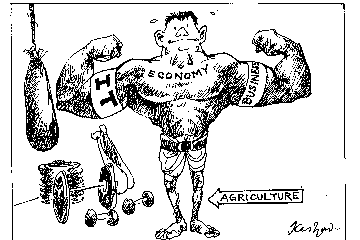
This post is about Keshav's cartoon about the indian economy which appeared in the Hindu today. So, you see, I couldn't have done anything else but to paste this cartoon in my blogpage.
As IT grows, so does the divide between the rich and the poor. Every now and then we hear the slogans of "India Inc." and "India Shining". Is the availability of the fruit kiwi in food world the index of India's shine? Or is the stock exchange a mirror of the true India? IT, or all these multinationals provide jobs to a miniscule fraction of people in India. I agree that it brings in a lot of capital to India, but this capital remains in the hands of the select few.
Its a pity that communism did not work.
Ironically enough, I was seeing this cartoon on my laptop's TFT monitor.

Thursday, November 02, 2006

The newspaper read "Good Morning Bengalooru" (Gosh, I still can't spell it, and perhaps, I don't want to spell it that way). Karnataka became more Suvarna today. Kannada language was enriched today. Today is a proud day for every Kannadiga.
I fail to understand what changing the name of a city has to do with Karnataka becoming Suvarna. I'd rather say that it is a sad day for Karnataka. I wonder how much money must have been spent to change the name of Bangalore (which sounds so good) to Bengaluru. Where did this money come from - the tax payer's pocket. There were so many ways to spend this money in a better way, but alas, all they decided to do was to change the name. Vote bank politics. First, make the Kannadigas feel that their culture and language is under threat, and then, do something to make them feel more secure. That will fetch you votes. At the same time destroy the country.
Come to think of it another way, does it really fetch votes? I mean, the number of votes is constant, and every party is lobbying for the same thing, every party plays the same partisan politics - give more quotas to SCs and STs, change the name of Madras to Chennai, Calcutta (I still love the name Calcutta and I refuse to use the name Kolkata - yes, I am a Bengali) to Kolkata and Bangalore to Bengaluru. So if one fine day, all parties suddenly decide to stop doing partisan politics -- now note here that I'm not asking these parties to work dedicatedly and sincerely for the betterment of the country, but to do something which won't harm their vote bank and satisfy me and many others like me as well -- none of the parties will lose votes; rather they would get a chance to gain more votes because if they stop doing partisan politics, India, some day will become a super-power and poverty will be reduced. More money will flow in. More money means more guns. More guns in the hands of thugs will enable the same parties to do more rigging during elections.
I don't understand why all these political leaders don't have the common sense to understand that their election budgets are, in a way, restricted by the Indian economy. If the economy grows, their election budget will as well.
Make me the prime minister. I will, at least, rule the country with common sense, if not with sincerity and patriotism.

Sunday, October 29, 2006

Its Sunday today, and after a long time, I am not at my aunt's place on a Sunday. Sunday is mostly meant to be a holiday - I reckon this is Europe, or more specifically Christianity's gift to the world. Perhaps, it was originally a mandatory holiday to allow people to go to church and pay due respects to Rome's authority.
Over the centuries things haven't changed much. I'm not talking of people still going to church on Sundays. That context is meaningless in today's world - only a ritual everyone does for old times' sake.
The real essence of Sunday today lies in consumerism - the very thing that drives the economies of the world. Six days a week you strive hard in your factories to make the things which you are 'told' you need, and on the seventh day, the same factories give you a holiday for you to go and buy what you produce.

Friday, October 27, 2006

My colleagues say that I really think out of the box. I disagree with them. My ideas are as down to earth and as normal as they can be. I don't know what made them brand me as an out-of-the-box-thinker, but the other day my ideas almost had all of them fainting on the floor. I only said that they should design the next Power machine with a robotic arm which spanks the user on the head and says "you idiot" when he types an incorrect command, grabs his head and makes him read the automatically opened manual page. Read the f***ing manual. Now, really, I don't think this idea is as much out of the box as the idea of eating rice with a pair of chopsticks.

Monday, October 16, 2006

Finally we are moving to a new house tomorrow. This house that we are living in now is no better than a dungeon - perhaps a prisoner rotting in the dungeons of a medeaval knight, as described by Mark Twain, will find me a little better than him, but again, that would be debatable. Bangalore is a city blown out of propertion, a city trying to become what it is not, trying to become what it can perhaps never become, trying to become what it should not become. It shows everywhere - the way people talk, the way houses are built, the way the roads are designed, the way people drive their cars, the way offices are designed, so on and so forth, the list will be endless. No one bothers about the laws, nor does anyone have any of the civic sense South Indian people were revered for earlier. People drive over dividors, ride their bikes into footpaths. While building houses people don't follow the regulations, but save a lot of construction cost by having a common wall for two houses.
Enough of cribbing. I am finally moving to a house in which one knows whether its the day or night when the clock shows 12 AM.

Monday, September 11, 2006

I haven't updated my blog in a while, and I guess it is ok not to do so. Writing is something that should not be done as a profession; when one is asked to produce words on demand, at best a soulless beauty is produced. My uncle once told me, to write something, one should be like a glass filled to the brim, the convex surface of the water above the edge, and then a single drop more is enough to serve as a trigger to spill all the water over.
One may argue that it may not be so - columnists produce columns at regular intervals, and even Ruskin Bond published beautiful stories in the Telegraph every week. We forget one thing, how often different people feel varies widely, and it was not necessary for Ruskin Bond to follow a routine and write one story every week. He had the liberty to write his stories and keep them for later use.
The only people, who, I grant, can do something at regular intervals and still produce something soulful are cartoonists.

Tuesday, August 29, 2006

Now one can write blogs by using mail. Isn't it wonderful? This is my first attempt at using this feature.

Monday, August 28, 2006

Ustad Bismilla Khan Ji died a passed away days ago. Ustadji, single-handedly, took up a folk instrument having its origins in Persia in his hand, and turned it into a classical instrument - such was his genius, such was his devotion to music. The demise of Ustadji has left Shehnai crippled.

Listening to a record of Ustadji, I remembered listening to an interview of Ustad Vilayat Khan a few years ago where he said, "Thumri gaane ke liye allah miya ek alag dil dewe." Ustad Bismillah Khan Ji was the only person had that "dil" when it came to the world of Shehnai. The heart of Shehnai has stopped beating.
We were talking about attitude recently, and a senior of mine, who has just completed his masters from an IIT, expressed his disappointment at the attitude of students in IIT; the students who are the brightest minds in the country, the students who are to be the future of the nation. He would get really frustrated seeing them leave the lights and fans switched on all the time. In his hostel, there was a toilet flush which would keep flowing, if, after use, the knob was not manually turned the other way round, and amazingly, there were very few students who would take the 'pain' of doing this simple thing. My senior put up a notice in the toilet drawing attention to the problem and listed the simple solution. Nothing changed.

In contrast, another senior of mine narrated another tale about the attitude of a four year old child. He was travelling by a train in Germany by which a four year old girl and her father were also travelling. The girl was licking an ice cream cone in her hand when the ice cream fell on the floor. Silently, the girl took out a polythene bag from her father's bundle, picked up the stuff from the floor and put it in the bag. She then took her handkerchief, wiped the floor with it, put the handkerchief in the polythene and replaced the polythene back in her father's bundle. And all this while, her father took no notice of what the little girl was doing and kept looking out of the window.

Friday, August 25, 2006

Isn't it rather strange that an attention seeker like Janis Joplin would sing a song like "Me and my Bobby McGee"? It is even more strange that she sang these few lines in the same song :

Freedom's just another word for nothin' left to lose
Nothin', that's all that Bobby left me, yeah
But, feelin' good was easy, Lord, when he sang the blues
Hey, feelin' good was good enough for me, Mm-hmm
Good enough for me and my Bobby Mcgee

And in another song, she sings in a very atrocious voice, which, obviously is to draw to herself the attention she always seeked in her life :
This is a song of great political and social importance

Oh lord, wont you buy me a mercedes benz ?
My friends all drive porsches, I must make amends.
Worked hard all my lifetime, no help from my friends,
So lord, wont you buy me a mercedes benz ?

Another time, a photographer wanted to shoot her, and she started stripping. The photographer explained to her that he would rather have her with her clothes on, but she stripped anyway, and that photograph is, till date, the most famous photograph of Janis Joplin.

Ironically, a few months before her death, it is said, that someone told her, "We actually liked you."

Though this be madness, yet there is a method in't.